

Optimizely Cyberattack: At Least 178 Organizations Affected, and Why Website Security Controls Matter

Public Service Cybersecurity Advisory | Sera Brynn | November 18, 2026
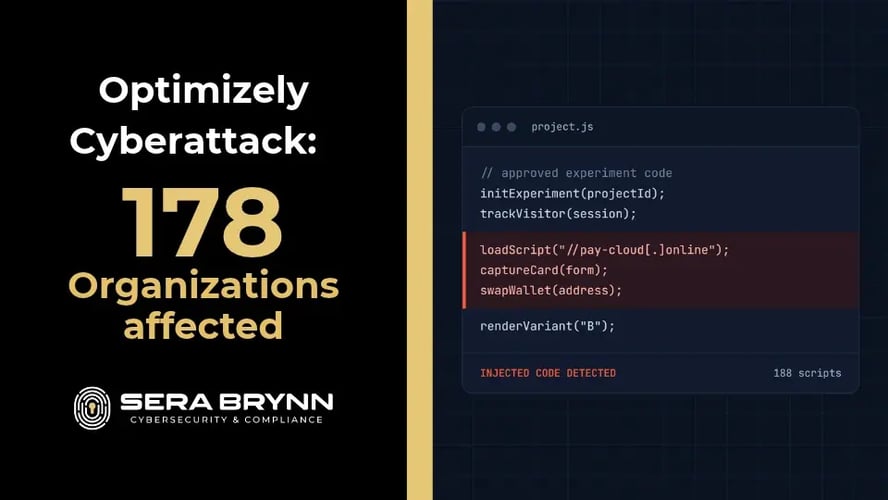
On November 16, 2026, attackers exploited a vulnerability in Optimizely, a widely used website optimization platform, to distribute malicious JavaScript through legitimate websites.
Security researchers identified 188 infected scripts associated with at least 178 organizations, including CNN, BBC, Zoom, Salesforce, HSBC, IKEA, and Equifax. The actual number may be higher.
The malicious code was capable of stealing payment card information, redirecting cryptocurrency transactions, capturing browser information, and attempting to compromise vulnerable iPhones and iPads.
Visitors did not need to click a suspicious link or download anything. Loading an affected website could be enough to execute the malicious code.
Optimizely reports that the vulnerability has been fixed and the malicious code removed. However, its investigation with Mandiant continues.
The bigger cybersecurity concern is how easily trusted third-party code can expose customers, even when a company’s own systems have not been breached.
What Happened?
Optimizely’s Web Experimentation platform allows businesses to test website designs, personalize content, and analyze visitor behavior.
Many organizations deploy the platform by loading a JavaScript file directly from Optimizely’s servers.
Attackers exploited a flaw in Optimizely’s account signup process that allowed them to impersonate legitimate administrators without obtaining their passwords.
They modified customer Project JavaScript to insert malicious code. When affected websites loaded that JavaScript, visitors’ browsers could execute the attackers’ instructions.
The attack was not caused by the compromise of 178 separate corporate networks. Instead, attackers exploited a shared technology provider trusted by those organizations.
Optimizely confirmed that its high-security PCI CDN, cdn-pci.optimizely.com, was also susceptible to the injection mechanism.
The company reports that Web Experimentation was the affected product. Feature Experimentation, the SDKs, and legacy Full Stack were not affected, and Optimizely found no indication of impact to its other products.
What Could the Malware Do?
Independent researchers at Report URI identified four primary malicious capabilities.
1. Payment card theft
The code attempted to capture credit card numbers, expiration dates, and security codes entered into website forms.
This type of attack is known as web skimming or formjacking.
Payment information entered through properly isolated third-party payment iframes, such as those provided by Stripe or Adyen, was outside the identified malware’s reach.
Optimizely has not confirmed whether payment card information was actually stolen.
2. Cryptocurrency theft
The malware could replace legitimate cryptocurrency wallet addresses with addresses controlled by attackers.
A visitor attempting to send funds to a legitimate recipient could unknowingly send them to the attackers instead.
According to Bitquery’s November 17 blockchain investigation, approximately $2,260 in 19 payments reached the identified attacker wallets.
Bitquery notes that one $51 transaction may not have been victim-related. Excluding it would reduce the estimate to approximately $2,210.
These figures are blockchain-derived estimates, not a comprehensive accounting of all potential losses.
3. Browser cookies and screenshots
The malware could collect browser-readable cookies and screenshots under certain conditions, particularly when cryptocurrency addresses were replaced.
Cookies protected by the browser’s HttpOnly attribute were not directly accessible through the identified JavaScript mechanism.
The number of exposed browser sessions, if any, remains unknown.
4. iPhone and iPad exploitation
Report URI identified delivery mechanisms associated with the Coruna and DarkSword exploit kits.
The malware targeted devices running vulnerable versions of iOS and iPadOS.
The number of successfully compromised devices has not been established.
When Did the Attack Occur?
Optimizely’s November 17 incident report provides the following milestones for November 16, 2026.
There is an important discrepancy between the vendor’s containment account and independent observations.
Report URI observed an earlier suspicious injection at approximately 04:21 UTC. Its subsequent sweep between 19:24 and 19:59 UTC still identified 186 infected Optimizely snippets. Researchers also documented additional malicious infrastructure becoming active after 16:06.
Optimizely maintains that the 16:06 action blocked malicious delivery. The continued presence of infected snippets does not, by itself, prove successful execution after that point, but it warrants careful investigation.
Organizations should preserve records for the entire day of November 16 rather than assuming exposure ended at 16:06 UTC.
Customer-specific exposure timelines should be obtained directly from Optimizely.
The Most Important Finding: Many Website Security Controls Were Ineffective
One of the most revealing findings came from Report URI’s analysis of Content Security Policy (CSP) configurations.
CSP is a browser security mechanism that restricts where scripts can load from and where website code can transmit information.
Report URI examined 256 hosts associated with affected organizations.
Its published breakdown included:
68
The published categories account for 159 of the 256 hosts examined. The report does not fully classify the remaining 97, so these figures should not be interpreted as a complete distribution.
The critical distinction is that having a CSP configured did not necessarily stop the attack.
Some policies allowed scripts from overly broad sources. Others included settings such as unsafe-eval or strict-dynamic, which could permit malicious execution under the conditions identified by researchers.
In 17 cases, the policy restricted outbound data transmission but still allowed the cryptocurrency address substitution to operate.
A security control can exist, be documented, and even pass a basic configuration review without providing the intended protection.
The question is not simply whether a security control exists. It is whether that control works against the threats it is supposed to address.
That requires testing, validation, and ongoing monitoring.
This Is Also a PCI DSS Security Controls Issue
For organizations handling payment cards, this incident highlights risks already addressed by PCI DSS.
Two requirements are particularly relevant.
PCI DSS Requirement 6.4.3: Payment-page script management
Organizations subject to this requirement must manage payment-page scripts loaded and executed in consumers’ browsers, including:
- Confirming that scripts are authorized.
- Assuring the integrity of those scripts.
- Maintaining an inventory with a documented business or technical justification for each script.
PCI DSS Requirement 11.6.1: Change and tamper detection
This requirement addresses detecting and alerting on unauthorized changes to security-impacting HTTP headers and payment-page script contents as received by the consumer’s browser.
The required monitoring frequency is at least once every seven days or according to a targeted risk analysis, as permitted by the standard.
However, an attack capable of causing harm within hours demonstrates why organizations should evaluate whether their monitoring and alerting are fast enough for their actual risk.
These requirements do not apply identically to every website or payment architecture. Applicability depends on PCI DSS scope and the organization’s payment implementation.
The Optimizely incident does not establish that any particular organization violated PCI DSS.
It does demonstrate why assessors and security teams must evaluate whether payment-page security controls are effectively implemented and operating as intended.
Compliance documentation is not a substitute for security effectiveness.
Businesses Should Do Immediately
1. Determine whether you were affected
If your organization uses Optimizely Web Experimentation, do not assume it was unaffected.
Optimizely’s November 17 report states that customers who have not received a notice explicitly identifying their site as UNAFFECTED should assume impact and contact their Customer Success Manager.
Request the affected project IDs, precise exposure windows, and relevant change records.
2. Investigate and preserve evidence
Retain security records covering November 16, including website logs, CDN logs, WAF records, CSP violations, payment transaction records, and available browser-security telemetry.
Review any affected pages that accepted payment card information or facilitated cryptocurrency transactions.
Note that server-side logs alone may not capture malicious connections made directly from visitors’ browsers.
3. Inspect third-party scripts and security controls
Review all Optimizely Project JavaScript and custom experiment code.
Look for unauthorized modifications, unexpected script loaders, and changes to previously approved code.
Evaluate whether your CSP actually blocks unauthorized script execution and outbound data transmission.
For payment pages, verify script inventory, authorization, integrity controls, and tamper-detection mechanisms against applicable PCI DSS requirements.
4. Review sessions and credentials
There are two different recommendations worth understanding.
Optimizely’s position: Because the exploited account vulnerability did not involve stolen customer passwords, it does not require blanket password resets or API-token regeneration.
Report URI’s recommendation: Review and rotate Optimizely account access and integrations as a precaution, and treat potentially exposed session tokens or secrets stored in non-HttpOnly cookies as compromised.
These recommendations address different risks.
Organizations should distinguish the Optimizely account-access vulnerability from any potential compromise of website visitors’ browser sessions.
Revoke or rotate credentials and session tokens where exposure is established or reasonably suspected.
5. Evaluate customer notification obligations
Determine whether sensitive information may have been exposed.
Engage incident response, legal, and privacy personnel as appropriate.
Evaluate contractual obligations, payment-brand requirements, and applicable breach-notification laws.
What Individuals Should Do
If you visited an affected website on November 16, consider the following precautions.
Update your Apple devices. Report URI recommends iOS or iPadOS 18.7.3 or later for devices on the 18.x branch, or 26.3 or later for devices on the 26.x branch. Install the latest available security update for your device. Seek additional assistance if you suspect a device was compromised.
Review payment activity. If you entered payment card information into an affected website form, monitor your transactions and contact your card issuer about suspicious charges.
Verify cryptocurrency transfers. Check the actual destination addresses of transactions made during the incident. For future transfers, independently verify wallet addresses, preferably on a trusted hardware wallet display.
Monitor sensitive accounts. Watch for suspicious sessions or account activity. If you believe session information was exposed, use the affected service’s session-revocation features where available.
Clearing your browser cache or cookies alone does not necessarily invalidate a session token that has already been copied.
Not everyone who visited an affected website was necessarily compromised. Exposure depends on the specific page, time, device, and actions performed.
Indicators of Compromise
Optimizely and Report URI have published technical indicators that organizations can use during their investigations.
The two sources provide different sets of indicators.
Optimizely’s official preliminary indicators focus on the payment-skimming infrastructure, including pay-cloud[.]online, pay.pay-cloud[.]online, and pay-relay.wordpressadmin001.workers[.]dev.
Report URI’s broader technical analysis identifies additional malware delivery infrastructure, iOS exploit domains, code signatures, and cryptocurrency wallets.
Security teams should consult both source lists rather than rely on a partial collection of indicators.
The Lesson for Business Leaders
The Optimizely incident illustrates how a vulnerability in a trusted technology provider can create exposure across hundreds of websites without requiring attackers to compromise each organization’s infrastructure.
Businesses must understand which third-party scripts run on their websites, what those scripts can access, and whether security controls will identify or stop unauthorized behavior.
The answer is not simply to deploy more security tools.
It is to ensure existing controls are properly designed, implemented, tested, and monitored.
A trusted vendor is not the same thing as trusted code. And a documented control is not necessarily an effective control.
That is the lesson organizations should take from this attack.
This public service advisory reflects information available as of November 18, 2026. The investigation remains ongoing, and findings may change.
Sera Brynn | Independent Cybersecurity Assessments
FedRAMP 3PAO | GovRAMP 3PAO | CMMC C3PAO