A New Era of Accountability
Starting November 10, 2025, the Department of Defense begins enforcing the Cybersecurity Maturity Model Certification (CMMC) through federal solicitations. This marks a major turning point for the Defense Industrial Base. Every cybersecurity claim, from SPRS scores to policy statements, will now carry legal weight under the False Claims Act (FCA).
The Department of Justice (DOJ) has already shown its intent through the Civil Cyber-Fraud Initiative, targeting contractors that overstated compliance with DFARS 252.204-7012 and NIST SP 800-171. With CMMC enforcement in place, the government’s focus has shifted from good-faith effort to provable accuracy.
Understanding how CMMC enforcement intersects with the False Claims Act is now essential for every contractor who wants to protect eligibility, reputation, and revenue.
Why Accuracy Is Now a Legal Requirement
For years, contractors relied on self-attestation when submitting cybersecurity compliance scores in the Supplier Performance Risk System (SPRS). These submissions were often based on internal interpretations and documentation.
Now, the Department of Defense has introduced a second layer of verification through independent assessments by Certified Third-Party Assessment Organizations (C3PAOs). Once verified results exist, discrepancies between self-reported scores and assessed findings will become clear.
Whether the discrepancy results from oversight or misunderstanding does not matter. Under the False Claims Act, accuracy itself is considered material to contract eligibility and payment. That means contractors must be able to prove every control they claim to have implemented.
Action Step: Treat every SPRS entry as an auditable statement. Align internal documentation with assessment-ready evidence before submission.
Understanding the CMMC Enforcement Timeline
The Department of Defense will phase in CMMC requirements over several years. Each phase increases the level of certification required for new solicitations, moving toward full enforcement by 2028. The timeline below, published by the Department of Defense, shows when each phase begins and what level of certification applies.
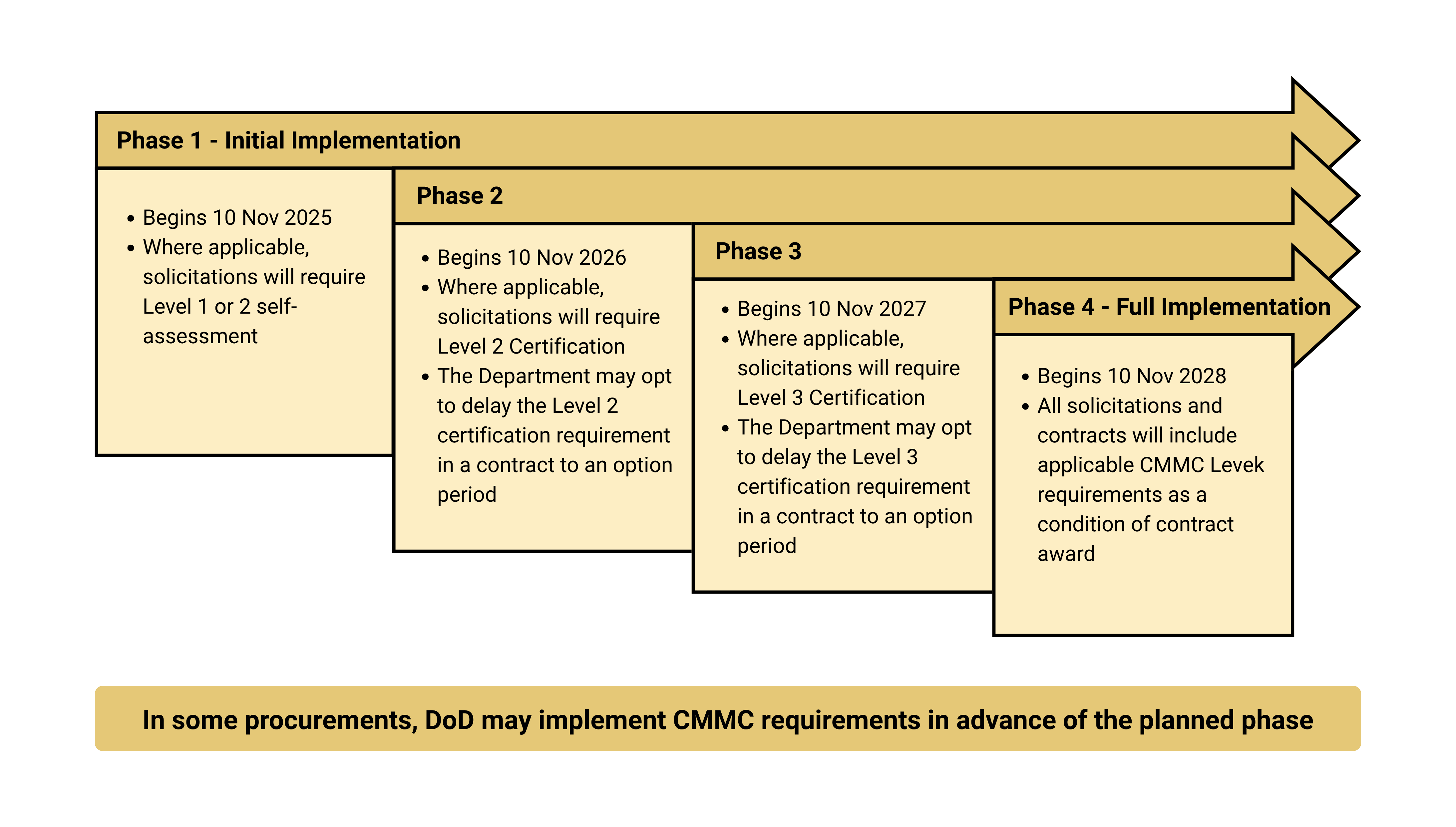
Figure: CMMC enforcement timeline showing the phased rollout from 2025 to 2028. Phase 1 begins November 10, 2025, requiring self-assessments. By Phase 4 (November 10, 2028), all DoD solicitations will mandate CMMC certification as a condition of contract award. |
Note: In some procurements, the Department of Defense may implement CMMC requirements earlier than planned. Contractors should prepare now to ensure readiness before their specific phase is enforced.
Lessons from Recent DOJ Cases
Recent settlements show how seriously the DOJ is enforcing accuracy.
- MORSECORP (March 2025) paid $4.6 million after claiming full NIST SP 800-171 implementation while using an unapproved email provider.
- Raytheon (RTX) and affiliates (May 2025) agreed to pay $8.4 million for certifying compliance without fully implementing required controls.
Neither company experienced a data incident. Both were penalized for inaccurate compliance claims.
These cases make one point clear: passing an assessment does not erase earlier inaccuracies. Any mismatch between what you reported and what an assessor later verifies can trigger FCA scrutiny.
Building Evidence Integrity: Your First Line of Defense
CMMC changes the role of compliance documentation. Evidence must now be dated, traceable, and verifiable. To withstand government or third-party review, your records must show that security controls are not only implemented but also remain effective.
Common weaknesses include:
- Documentation that does not reflect real system configurations
- Over-reliance on third parties without clear accountability
- Policies that do not match technical practice
Action Steps to Strengthen Evidence Integrity:
- Maintain date-stamped proof of each control implementation
- Validate that policies and configurations align quarterly
- Document third-party responsibilities in writing
- Keep historical records of all security changes
Accuracy and traceability are no longer best practices; they are safeguards against legal exposure.
How to Stay FCA-Compliant Under CMMC
The best protection against False Claims penalties is preparation. Contractors should focus on six key actions:
- Cross-check evidence against SPRS entries before submission.
- Conduct internal readiness reviews every quarter to identify discrepancies.
- Ensure third-party tools and services are documented and approved.
- Retain assessment artifacts and proof of ongoing control effectiveness.
- Train staff on the legal importance of accurate reporting.
- Partner with experts. Work with a proven advisory firm like Sera Brynn or one of our preferred partners. Choose firms with Certified CMMC Assessors (CCA), Certified CMMC Professionals (CCP), or is a Registered Provider Organizations (RPO).
Avoiding penalties starts with systems that can prove compliance, not just claim it.
Preparing for What Comes Next
CMMC enforcement is not just another compliance milestone. It signals the end of unchecked self-attestation and the beginning of provable accountability. Contractors who invest in accuracy and documentation now will protect both their eligibility and their reputation. Those who rely on outdated or inflated claims risk financial and legal consequences that extend far beyond a failed audit.
Bottom Line: CMMC has raised the bar from good-faith effort to verifiable accuracy. Honest, consistent, and evidence-backed compliance is now the only path forward.
How Sera Brynn Can Help
Sera Brynn is an Authorized CMMC Assessment, FedRAMP Assessment and GovRAMP Assessment with extensive experience guiding defense contractors through complex cybersecurity requirements.
Our certified assessors work directly with clients to:
- Validate evidence and identify documentation gaps
- Align self-reported SPRS scores with verified assessment data
- Strengthen system security and reduce FCA exposure
Schedule a CMMC readiness consultation today to ensure your compliance claims are accurate, verifiable, and defensible before enforcement begins.